An Independent Publishing House in Berlin
Odýsseía Publishing is an independent publishing house based in Berlin, creating books primarily for children and young people.
Our publications engage with Europe through its history, culture, societies and ideas. We are interested in how the past remains present: in institutions, language, architecture, traditions, political structures and everyday life.
Our publishing programme will grow across different subjects, formats and age groups, with a particular focus on children and teenagers. What connects these publications is an interest in placing the contemporary world in a broader historical and cultural context.
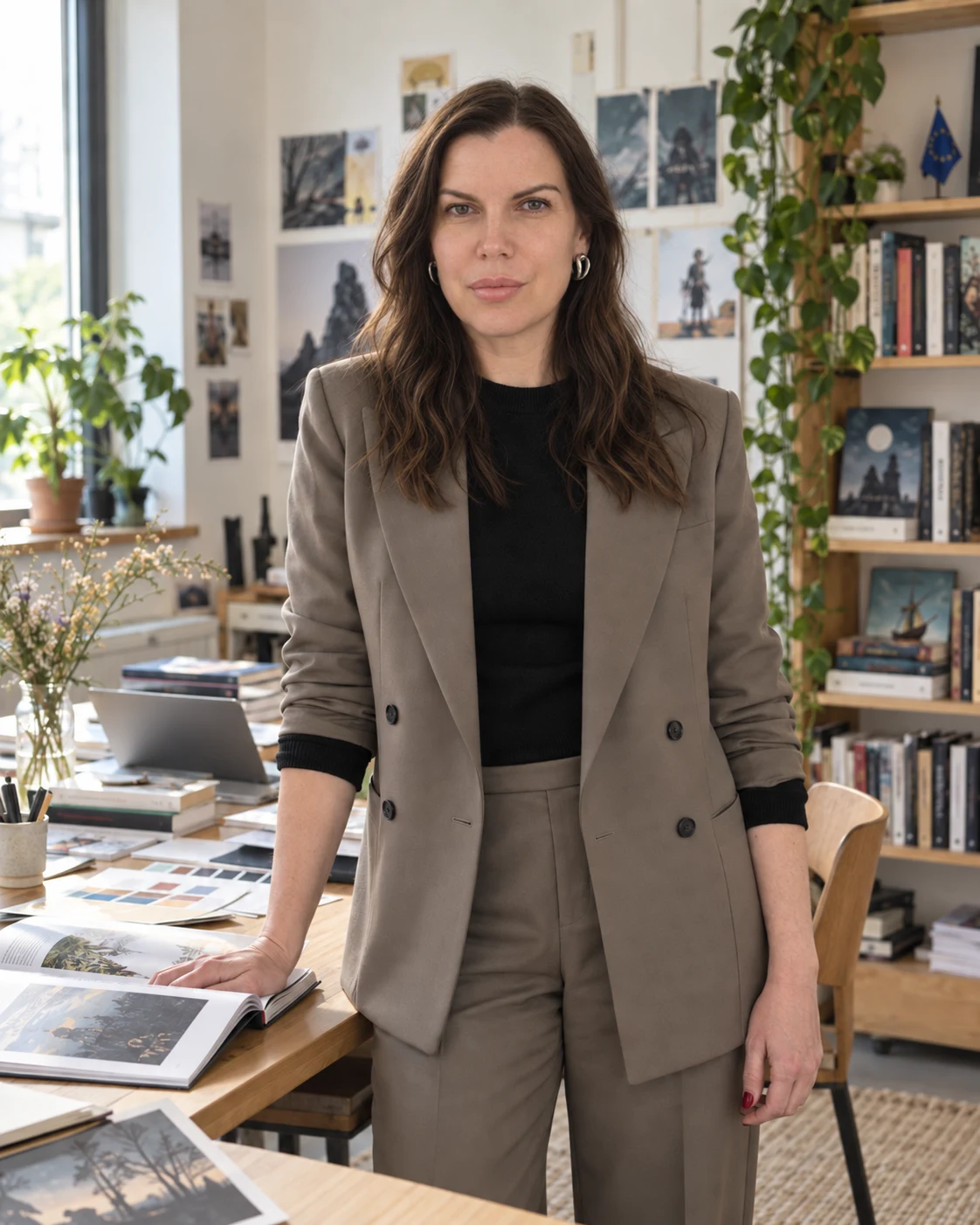
Odýsseía Publishing GmbH was founded by Dr. Joanna Grzelak-Piaskowska in 2026.
The book as a whole
We approach each book as a complete editorial work, considering writing, illustration, design and production as parts of the same whole.
We take young readers seriously. Complex subjects require clear language, careful selection and enough context to preserve what makes them significant.
Original illustration is central to our publishing. We work with artists whose individual visual language gives each book its own character. Typography and layout are developed as integral parts of the book's editorial conception.
The physical book matters too. Paper, printing, binding and finish shape how a book feels, ages and withstands repeated use. We want our books to have the material quality of objects made to be kept and returned to over time.
The way they are produced is part of the same approach. Our books are made in the European Union using responsibly sourced paper, and we work with European printers who share our standards for durability and quality.
Europe
Odýsseía is European by conviction as well as by subject.
Europe is not a single culture or a single historical narrative. It has been shaped over centuries by different languages, traditions, conflicts, exchanges, migrations and ideas.
Our books explore what makes individual places and cultures distinctive, while also tracing the historical, intellectual and political connections between them.
Contemporary democratic Europe did not appear fully formed. Its institutions and principles emerged from particular historical experiences, were repeatedly contested and continue to evolve. We are interested in making those histories visible, rather than presenting democracy, freedom or cooperation as self-explanatory abstractions.
Understanding Europe also means recognising that its history contains extraordinary cultural achievement and profound failures. Neither can be understood in isolation. The ability to examine the past critically is itself part of Europe's intellectual inheritance, passed from one generation to the next.
Why Odýsseía?
Homer's Odyssey is one of the foundational works of European literature.
Composed in ancient Greece almost three thousand years ago, it has been translated, retold and reinterpreted across languages, periods and cultures. Its continuing presence in European literature, art and thought makes it part of a cultural inheritance extending far beyond the world in which it originated.
An odyssey has also come to mean a long journey shaped by what happens along the way: encounters with the unfamiliar, changes of perspective, knowledge acquired gradually rather than received ready-made.
That understanding of a journey is close to how we think about reading.
Books carry cultural memory forward, but every generation encounters that inheritance from a different historical position. It reads old stories differently, asks new questions of them and adds stories of its own.
The name Odýsseía reflects this continuity: inherited culture is not static. It remains alive because it is continually read, questioned and understood anew.
Beginning in Berlin
Berlin is the natural starting point for Odýsseía.
It is the city in which the publishing house was founded and a place where many of the central questions of modern European history remain unusually visible: power and democracy, dictatorship and freedom, division and reunification, migration, memory, cultural change and political reinvention.
Our first book is devoted to Berlin. It also opens a series planned to explore Germany through its federal states, their distinct histories, landscapes, cultures and identities.
Berlin is therefore a beginning in two senses: the beginning of our publishing programme and the first point on a much larger planned map.